


John Penn: NC Signer of the Declaration of Independence

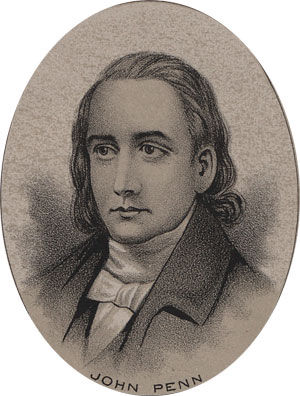
John Penn was born on May 17, 1741, near Port Royal, Caroline County, in Virginia, to Moses and Catherine Penn. He was an only child, and his family ancestry can be traced to England. His maternal Great-grandfather, James Taylor, immigrated to Virginia in 1735. He had been born at Pennington Castle, near Carlisle, England, and was descended from the Baron Taillefer who fought at the Battle of Hastings in 1066. Two of his other descendants are James Madison and Zachary Taylor. Another maternal Great-grandfather, Philip Pendleton, came to Virginia in 1674, and he was originally from Norwich, England. Philip was descended from George Pendleton Sr., Esquire, in Lancashire County, England. His paternal Grandfather, John Penn, also immigrated to America, but the exact date of his arrival in the colonies is unknown.
Not much is known about his early life; it is believed he attended a country school and studied law in his uncle Edmond Pendleton’s library from 1759 to 1762. He was able to do this because his father had died in 1759 and left him a comfortable fortune. Before this, he was an unmotivated individual, whose father did not think an education was important. By 1762, he had obtained his law license and moved to Bowling Green, Virginia.
On July 28, 1753, Penn married Susannah Lyne, who was the daughter of Henry Lyne. They would have three children together, with the first child born in 1762 and named William. William never married, and the date of his death is unknown. Their next child, a daughter, named Lucy, was born in 1766, and she married John Taylor of Caroline, who was a colonel in the Revolution. They have five children together.[1] She passed away in 1830, at Hazelwood, in Caroline County, Virginia. A third, unnamed child was born in 1768.
By 1774, Penn and his family had moved to Williamsboro, in Granville County, North Carolina. Many of his relatives had previously moved there, so they were near family. Another reason for the move was that Penn had been tried in court over some disrespectful remarks he had made about King George III and was convicted. However, the judge only fined him one penny, which he refused to pay. It is said that he spoke about taxation, the lack of representation, and that he had been with others who spoke of breaking away from the mother country. As it happened, he was the most vocal of the group and was the one prosecuted. This episode did not deter his involvement in politics, as he was sent to the Provincial Congress in August of 1775 and served on a variety of committees. It is estimated he served on 15 to 20 committees that included such items as forming a temporary government, preparing a constitution, and conferring with North Carolina inhabitants about joining the American cause. He had a reputation for tireless attention to duties and was elected to the Second Continental Congress on September 8, 1775.
He arrives in Philadelphia and takes his seat in Congress on October 12, 1775. In February of the next year, he wrote to Thomas Person and stated, “My first wish is that America may be free; and second, that she may be restored to Great Britain in peace and harmony and upon just terms.”[2] He would soon have abandoned this thinking after hearing from the other colonies, and he wrote to Brigadier General Thomas Pearson of the North Carolina militia: “For God’s sakes my Good Sire, encourage our People, animate them to dare even to die for their country. Our struggle I hope will not continue long – may unanimity and success crown your endeavors.”[3]
In April of 1776, he was a member of the Provincial Congress at Halifax, was in favor of independence, and never had doubts about it, unlike his fellow signers. He signs the Halifax Resolves and returns to Philadelphia for the July 2 vote on independence and signs the engrossed copy of the Declaration on August 2, 1776. During the congressional debates on the Declaration, there was a clap of thunder, and it appears Stephen Hopkins, of Rhode Island, who had dropped his cane, was startled by the noise. It is said that Penn was worried Hopkins had been started and assured him there was nothing to worry about, as Dr. Franklin’s lightning rod was atop the building. Hopkins is said to have replied: “I don’t give a dam about any rod of lightning bolt, I’m just tired of Dickinson’s long winded harangue.”[4]
He would be a member of Congress until 1777. During his tenure, he signed the Articles of Confederation in November of 1777 and was seldom absent from Congress. He would not be paid for his services, but occasionally he would have his travel reimbursed. Hooper and his fellow delegates would travel approximately 400 miles round trip to and from Philadelphia in less than ideal circumstances. Part of the reason for the lack of payment was that money had depreciated so much that the amount they would have been paid was just a pittance. He also declined a judgeship during his tenure. An interesting story is told about an incident between Penn and Henry Lauren, President of the Congress, who challenged Penn to a duel. Lauren was 54 and was considered an elderly gentleman. The reasons for the duel are unknown but are most likely the result of some slight to Lauren’s honor. On the day of the duel, they ate breakfast together and proceeded to the duel site. Penn not only helped Lauren’s get to the site but was able to convince him that they should settle their differences, and the duel was called off. He was re-elected in 1778 and served until 1780.
Upon his return to North Carolina, Penn became a member of the North Carolina Board of War and served in this position until the board was abolished in 1781. It was a powerful board that controlled North Carolina when Lord Cornwallis invaded. Penn and the board helped supply General Nathaniel Greene’s troops, as well as the guerrilla fighters commanded by Francis Marion. Hooper became the de facto dictator for a brief time because the other board members were useless. He clashed with the Governor, who was threatened by Penn’s success and complained to the legislature, which disbanded the Board.
In 1781, he was appointed to the Council of State but refused to serve due to illness and resumed his law practice. Two years later, he was appointed a tax collector for Granville County. Then, in March of 1784, Robert Morris appointed him a receiver of taxes for the Confederation in North Carolina, but he resigned this position a few weeks later, in April. He resumed his law practice in 1784 but remained a bondsman until 1785.
The North Carolina census of 1786 shows he and his family were living in the Island Creek District. Three members of his household were listed as white males between the ages of 21 and 60, along with 39 black members of the household between the ages of 39 and 50. Thirty-one additional blacks were listed as being either under the age of 12 or over the age of 40. No white females were listed in the household. This may have been due to the death of his wife, as evidenced by a will he made in 1784 that left his children as heirs but not his wife. The date of his wife’s death is unknown.
Penn died on September 14, 1788, and was buried on his property, a few miles from Stovall, North Carolina. His remains were reinterred under the Signer’s Monument at the Guilford Court House State Park in Greensboro, North Carolina, on April 25, 1894.
Tidbits He was described as having an attractive and congenial personality. None of the North Carolina signers lived beyond 50 years of age. He was a quick study and was given more responsibility because of this trait. Member of the Episcopal Church None of the North Carolina Signers were natives of North Carolina. During WWII, there was a naval ship named after him, and it participated in the battle at Guadalcanal but was sunk in 1943 by the Japanese. |
[1] Some documents claim she had no child, but there are direct descendants of John Penn living today, and she was the only Penn child to marry.
[2] Pittman, Thomas Merritt. “John Penn” Bill Thayer’s Website. May 1, 1904. Accessed September 25, 2015. http://penelope.uchicago.edu/Thayer/E/Gazetteer/Places/America/United_States/North_Carolina/_Texts/journals/The_North_Carolina_Booklet/4/5A*.html.
[3] Kiernan, Denise, and Joseph D’Agnese. Signing Their Lives Away: The Fame and Misfortune of The Men Who Signed The Declaration of Independence, (Philadelphia: Quirk Books, 2009) 203


Comments