


John Witherspoon: NJ Signer of the Declaration of Independence

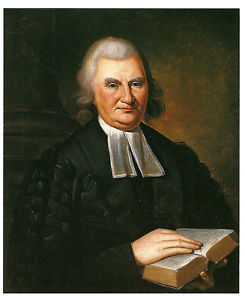
John Witherspoon was born on February 5, 1723, in Yester, which is near Edinburgh, Scotland, to James and Anna (Walker) Witherspoon. He was one of six children. One of his siblings would be lost at sea, in the West Indies. Reverend Witherspoon was descended from the Scottish Reformer, John Knox. His mother taught him to read using the Bible, and he was reading by the age of four. He then went to public school in Haddington, where he received a classical education. In 1735, Reverend Witherspoon was sent to the University of Edinburgh, where he completed four years of study in three, earning a Master of Arts in 1739. By 1742, he had earned a doctorate in theology and had a license to preach. He was offered the Parish at Yester but chose to go to Beith by 1745.
On September 2, 1748, Reverend Witherspoon married Elizabeth Montgomery, who was not well educated but was considered a very pious woman. They would have ten children together. Anne, their first child, was born in 1749. She would marry Reverend Samuel S. Smith on June 28, 1775, and pass away in April of 1817. Christian was born in 1750, but tragically, he died in 1756. Their next child, James, was born in 1751. He would be killed at the Battle of Germantown in 1777 and had attained the rank of Major by the time of his death. Robert was born in 1753, but his death is unknown. Another little girl, Barbara, was born in 1756 and died in 1763. Their son, John, who was born in 1757, became a doctor and passed away in 1796. Just two years later, in 1759, Francis was born. She marries David Ramsey on March 18, 1783, but he dies at the hands of a mentally deranged man on May 8, 1815, after having been shot two days earlier. She would pass away on November 11, 1784. Their last two children are boys named David, born in 1760, and George, born in 1762. David passed away in 1801, but before his death, he had studied law and relocated to North Carolina to open a practice. A total of five children would survive to adulthood and come to America. Elizabeth passed away on October 1, 1789.
On January 17, 1746, Reverend Witherspoon was a witness at the Battle of Falkirk and was taken prisoner. He was confined in the Castle of Doune, with several other spectators, even though he did not participate in the actual battle. There were two cells in the prison, with one full of spectators and the other full of military men, along with two alleged spies. The prisoners were able to talk with each other. They formed a plan to escape by climbing down a rope constructed of bedclothes. They had been locked in the highest part of the castle, some 70 feet above the ground. Around 1:00 am, they began to climb down with four reaching the ground successfully. The rope broke just as the fifth person reached the ground. The others were told what happened and not to attempt to descend, but they did not listen. Thomas Barrow descended the rope, reached the broken area, and let go. He received minor injuries, including a broken rib and ankle. Some of the men took him to the village and then out to a ship in the harbor. Reverend Witherspoon and Neil Macvicar remain behind, along with another volunteer. They draw up the sheets and attach blankets to them. A volunteer attempts to descend. He falls and dies from his injuries. Reverend Witherspoon wisely decided not to descend and was eventually released. Upon his release from prison, he transfers to Paisley and works with a larger congregation.[1]
He was elected the sixth president of the College of New Jersey in 1766, but refused the appointment. His wife was reluctant to travel across the ocean and leave her family and friends. For the next two years, Richard Stockton and then Benjamin Rush, who are in Scotland, attempt to convince him and his wife to come to New Jersey. Benjamin Rush was in Scotland, attending the University of Edinburgh, when he wrote to Reverend Witherspoon regarding his opposition to the Moderate Kirk Party of Scotland: “You can have no Prospects of rising into a high Sphere of Usefulness in the Church of Scotland…present ruling Faction have marked you out as an Object of their Resentment.”[2] Dr. Rush would continue to use his knowledge of what the Reverend was going through with the Moderate Kirks to entice him to accept the position at the College of New Jersey. During these two years, a wealthy, unmarried gentleman related to the family would attempt to persuade him to stay in Scotland by making the Reverend his sole heir. Reverend Witherspoon declines this offer and sails for America in 1768.
He and his family arrived in New Jersey in August of 1768, and he was inaugurated as the sixth President of the College of New Jersey. His work at the college would be immense and influential for years to come. He first set about growing the endowment fund and helping fix a schism in the Presbyterian Church. During his career, he would educate a variety of men who would change the course of this country. Twelve of his students were at the Continental Congress, and five of them would attend the Constitutional Convention. One of his graduates, James Madison, would go on to be President of the United States. Incidentally, after Madison graduated from the College of New Jersey, he would stay in Princeton an additional six months to study Hebrew and theology with the Reverend.[3] In addition to the above-mentioned distinguished men, he taught Aaron Burr, and 49 of his students went on to become Congressmen; 28 became U.S. Senators, 3 future Supreme Court Justices, and 8 U.S. District Judges. One of his students was a Secretary of State, and three were Attorneys General, with 28 former students serving as State Judges. Seventeen students would be members of their state constitutional ratifying conventions, with 14 former students as members of the Federal Constitution ratifying conventions in their respective states.[4] It should be noted that the same individuals held a number of these positions. In addition to his significant influence on students, he makes changes across every department to improve the curriculum. In the mathematics department, he introduces Euclid’s Elements, which is still in use in some schools today.
By 1770, Reverend Witherspoon’s students were publicly advocating for the patriot cause. He does not curb their enthusiasm for the cause; instead, he encourages it and joins in supporting it. He praises John Dickinson’s Letters from a Farmer in Pennsylvania. Not only was he advocating the patriots’ cause, but he was still working on the religious issues that are dear to him. It was during this time that he was a member of the Congregational Presbyterian Confederation, founded to foster cooperation between the two denominations. He would be a member of this organization until 1775.
From 1774 through 1775, he was a representative in the New Jersey Provincial Assembly, which successfully removed and imprisoned Royal Governor William Franklin. The governor was also the son of Benjamin Franklin. During this time period, Reverend Witherspoon was a member of Somerset’s Committee of Correspondence, as well as New Jersey’s Committee of Correspondence. He was the first public official in New Jersey to call for independence and was elected to the Second Constitutional Convention on June 26, 1776. He believed in the common man and their ability to make rational choices for themselves. He supported Thomas Paine’s Common Sense but used a pseudonym to do so. Before his election to the Second Continental Congress, he wrote a variety of pieces, including Thoughts on American Liberty, which urged the Continental Congress to take a stand against Britain in 1774, and then The Dominion of Providence over the Passions of Men, which was a sermon that stated God was on America’s side in this conflict. He believed the struggle would be over religious freedom and political liberty.[5] He wrote in this piece:
“If your cause is just, you may look with confidence to the Lord and entreat him to plead it as his own… I willingly embrace the opportunity of declaring my opinion without any hesitation that the cause in which America is now in arms is the cause of justice, of liberty, and of human natures… The knowledge of God and his truths have from the beginning of the world been chiefly, if not entirely, confined to those parts of the earth where some degree of liberty and political justice were to be seen; and great were the difficulties with which they have had to struggle from the imperfection of human society and the unjust decisions of usurped authority. There is not a single instance in history in which civil liberty was lost, and religious liberty preserved entire.”[6]
He would continue to write through 1776. He also believed that it was the government’s duty to promote public religion. He believed that America was a protestant nation. Reverend Witherspoon was suspicious of Catholics whose head of church was in Rome. He believed they were heretics. However, he believed that they needed to be tolerated in this country and posed no great harm, because the country was overwhelmingly Protestant. At this time, there were about three million Protestants in the country, versus thirty thousand Catholics and two thousand Jews. [7]
He takes his seat in Philadelphia a few days before the July 2 vote on independence. Prior to the vote, when another gentleman was saying that the country was not yet ready for independence, Reverend Witherspoon retorted, “Sir, in my judgement the country is not only ripe, but rotting.”[8] He allegedly wore his minister’s colors every day in Congress, even though he was acting in the capacity of a representative and not a minister. He helped organize the Board of Treasury and drafted several important documents, including a letter to the Marquis de Lafayette thanking him for his service, as well as Franklin's credentials and instructions as Minister Plenipotentiary to France. Additionally, he participated in the design of the Treasury and Navy Department Seals. Reverend Witherspoon would serve on a total of 126 committees.[9] Those committees would include the Board of War, the Committee of Foreign Affairs, the Secret Committee, and one committee concerning the printing of the Bible by Robert Aitken, who had translated it. Congress approves the resolution, written by Witherspoon, concerning this translation, with very few changes. In December of 1776, Reverend Witherspoon drafted a Religious Proclamation for Congress, expressing a day of fasting and humiliation. He would write two more of these proclamations before leaving Congress.
He also favors a strong confederation of states to form a national government, which could raise revenue and engage in commerce effectively. Had some of his ideas been enacted in the years between the Revolution and the Constitution, our country would have looked very different. He, like Hamilton, would believe in an energetic government. He will sign the Articles of Confederation, but will not be involved in the Constitutional Convention. He left Congress in 1782.
Just like everyone else, Reverend Witherspoon would experience personal and professional lows during the Revolution. The College of New Jersey would close in 1776 when the war reached Princeton. The British would occupy the college and burn its fine library. Many of the books in this library were brought to Princeton from Scotland by Reverend Witherspoon. He would attempt to restore the library but would die before it was completed. His own personal papers were destroyed as well. The college would reopen in November of 1778. Then, in 1777, his son James died at the Battle of Germantown in Pennsylvania.
Upon his exit from Congress, he returns to New Jersey and resumes his duties as President of the College of New Jersey. But in 1784, he withdrew from many of those duties, as he wanted to retire. He will retain the title of President of the college until his death. His son-in-law, Reverend Samuel Smith, will succeed him as college President and perform the duties of the office until he officially assumes the title upon Reverend Witherspoon’s death. In 1785, he led a movement to organize the Presbyterian Church, and through his work, a form of church government emerged, along with materials on catechism and other issues. He would hold this position until 1789, when he would finally open the first General Assembly with a sermon. The only interruption to this work was his participation in the New Jersey Constitutional Ratifying Convention in 1787.
His wife, Elizabeth, died in 1789, and he would also lose his eyesight after falling off a horse. His excellent memory enables him to continue delivering sermons, even though he can no longer see well enough to read. It was said that before his blindness, if he read a piece three times, he could repeat it verbatim. Exactly one month after the death of his wife, he would return to the New Jersey Assembly. The causes he was interested in upon his return included the treatment of prisoners, pensions for invalids, public debts, the promotion of religion and morality, divorce, paper money, the establishment of vital statistics records, and the encouragement of manufacturing. He also chairs a committee to abolish slavery in New Jersey around 1790. Ironically, he was a slaveholder, and it appears that the few slaves he owned took care of his property. He favored gradual emancipation, and in 1804, New Jersey passed an Act for the Gradual Abolition of Slavery. He publicly ridicules the Georgia Constitution, which prohibits ministers from holding public office.
On May 30, 1791, he married Anne Marshall Dill, who was 23 years old at the time of their marriage. They would have two children together: one, Francis, who was born in 1792 and died in infancy, and the other, Marianne, who was born in 1794. She will marry James S. Woods and have six sons and three daughters before passing away in 1846. Unfortunately, she will never know her father as Reverend Witherspoon passes away on November 15, 1794, at his home, Tusculum. There were a variety of physical ailments that occurred in his elderly years, and this contributed to his death. He is buried in the President’s Lot in Princeton, New Jersey.
Reverend Witherspoon was the only active clergyman and President of a college to sign the Declaration. He believed in the concept of a true religion, which he identified as Christianity. He states in the Dominion of Providence: “There can be no true religion till there be a discovery of your lost state by nature and practice and an unfeigned acceptance of Christ Jesus as he is offered in the gospel.”[10] This would have broad meaning because, as a staunch Calvinist, his works do not always take on the tone of a Protestant reformer. He respected several faiths, including the Anglican Church, and especially admired George Whitfield. While he was suspicious of Catholics, he did admire some treatises written by various Catholic popes. However, his focus tended to be on good behavior rather than the distinctions that defined different doctrines. He wanted to see universal practice because “salvation of our souls is the one thing needful.”[11]
Like other Founders, Reverend Witherspoon believed that virtue was essential for a republican government. However, he also held that religion played a key role in fostering virtue, since being virtuous meant having good moral character, and religion was seen as a foundation for developing such character. For republican governments to succeed, even when immoral men are leaders, citizens must have good character. According to Jeffrey Morrison, Reverend Witherspoon’s idea of the relationship between religion and republicanism was “no republic without liberty, no liberty without virtue and no virtue without religion.”[12] In essence, it was all interrelated.
Tidbits He was 6 feet tall and was known for his punctuality and exactness. He always celebrated the last day of the year by fasting and praying. He admitted two free blacks to the College of New Jersey and privately tutored them. |
[1] Pomeroy, R.W. "Biography of the Signers to the Declaration of Independence" The Port - Folio, 1824
[2] Mailer, Gideon. "Anglo‑Scottish Union and John Witherspoon's American Revolution" William & Mary Quarterly 67, no. 4 (October 2010): 729
[3] Mailer, Gideon. "Anglo‑Scottish Union and John Witherspoon's American Revolution" 732
[4] Morrison, Jeffry Hays. "John Witherspoon and `The Public Interest of Religion’" Journal of Church & State 41, no. 3 (Summer 1999): 553
[5] Moss, Sandra. "John Witherspoon: Religion and the American Revolution in New Jersey" Social Science Docket 8, no. 2 (2008), 51
[6] Moss, Sandra. "John Witherspoon: Religion and the American Revolution in New Jersey" 52
[7] Moss, Sandra. "John Witherspoon: Religion and the American Revolution in New Jersey" 51
[8] Goodrich, Charles A, Lives of the Signers to the Declaration of Independence. (New York: William Reed & Co., 1856) Pages 216
[9] Morrison, Jeffry Hays. "John Witherspoon and `The Public Interest of Religion'" Journal of Church & State 41, no. 3 (1999): 552
[10] Morrison, Jeffry Hays. "John Witherspoon and `The Public Interest of Religion'" 560
[11] Morrison, Jeffry Hays. "John Witherspoon and `The Public Interest of Religion'" 563
[12] Morrison, Jeffry Hays. "John Witherspoon and `The Public Interest of Religion'" 565



Comments