


Liberty Bell - Philadelphia

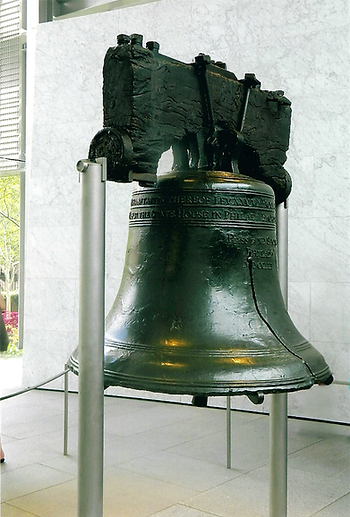
One of the things I love to do is travel to historic American places to learn about our history. One such place is Philadelphia, where I visited many historic spots within the city. Previously, I wrote about the “President’s House,” which was essentially the original White House when the capital moved from New York to Philadelphia prior to moving to its final location in Washington, DC. Today, I am going to focus on the Liberty Bell and the history behind it.
The Liberty Bell is located in the Liberty Bell Center between Independence Hall and the National Constitution Center. It is housed in a long rectangular glass building, which has a history of the bell on various displays that you walk through as you make your way to the bell. The bell is hung at the end of the building nearest Independence Hall and is surrounded by a metal railing to prevent people from going up to it and touching it. At the end of the building, there is a large window so that it can be viewed even when the building is closed.
For a little background and without giving the whole story away, the Bell was ordered for the tower of the Pennsylvania State House in 1751. The Pennsylvania State House is now known as Independence Hall. It was cast in London, England, at the Whitechapel Foundry, but cracked during its first test ring once it was brought to Philadelphia. It was then melted down and recast by Pass and Stow, and then hung in the State House. This is the bell the people would hear when lawmakers were called to their meetings or the townspeople were called to hear important news of the day.
The Liberty Bell was used for 90 years before a crack began to develop sometime in the early 1840’s. It is not the same crack from 1751, and the large crack we see today is a result of a repair to the damage that originated in the 1840s. This repair ultimately failed, and a second crack appeared, which rendered the bell silent. There is no one living today who has heard the bell ring.
Some key moments for which the Liberty Bell was rung are the opposition to the Stamp Act, the signing of the U.S. Constitution, and the funerals for Franklin, Jefferson, and Washington. Additionally, the quote “Proclaim liberty throughout all the land unto all inhabitants thereof” is inscribed on the bell.
Finally, while the bell has been taken to expositions and fairs across the United States after the Civil War, it is no longer moved and is on permanent display in Philadelphia, where two million people from across the globe visit it annually. It is truly a symbol of the American spirit and should be viewed by every American or potential American in their lifetime. It is a humbling experience.


Comments